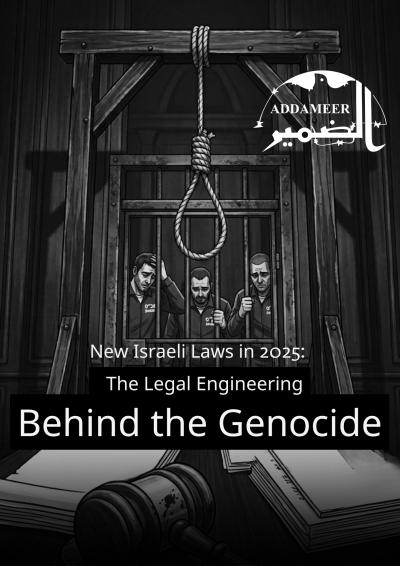
For the second consecutive year, in the aftermath of the genocide in the Gaza Strip, the Israeli occupying authority has persistently utilized legislation as a means to impose a new reality, infringing upon the fundamental rights of Palestinians under the guise of legality. Rather than serving as instruments to uphold justice and equality, the laws are applied selectively and with discriminatory intent, thereby institutionalizing racist and retaliatory practices. For years, Israel has endeavored to reshape its legal framework into a robust system that legitimizes and intensifies oppression, fostering an environment where crimes are perpetrated openly. Oppression has evolved from being a transient behavior to becoming an integral part of the legal and administrative framework itself, shielded by texts and regulations that provide it with cover and obstruct accountability.
The occupying power has taken advantage of the genocide in the Gaza Strip to systematically target the entire Palestinian population, with a particular focus on prisoners and their families. Since 7 October 2023, members of the Israeli Knesset have proposed a series of racist bills designed to reinforce the apartheid system and solidify the control and repression policies enacted by the occupying power against the Palestinian people. These bills have garnered significant support from both the ruling coalition and the opposition. Consequently, the Knesset has enacted over thirty new laws addressing various issues, including freedom of expression, protest, and thought; the right to citizenship and family life; equality and social rights; as well as the rights of prisoners and detainees, bringing the total number of racist Israeli laws to nearly one hundred.
This paper seeks to highlight the laws, as well as the draft laws that remain in various stages of the legislative process, which were introduced or enacted in 2025 and are aimed at further tightening restrictions on Palestinian prisoners in prisons, undermining any meaningful legal protections available to them, and creating a legal environment that enables impunity and shields those responsible for crimes committed against them from accountability.